
Artificial Intelligence, Business Growth, Pricing Strategy, Software Development
From Google Rankings to AI Recommendations: How Grawlix Is Redefining Digital Visibility

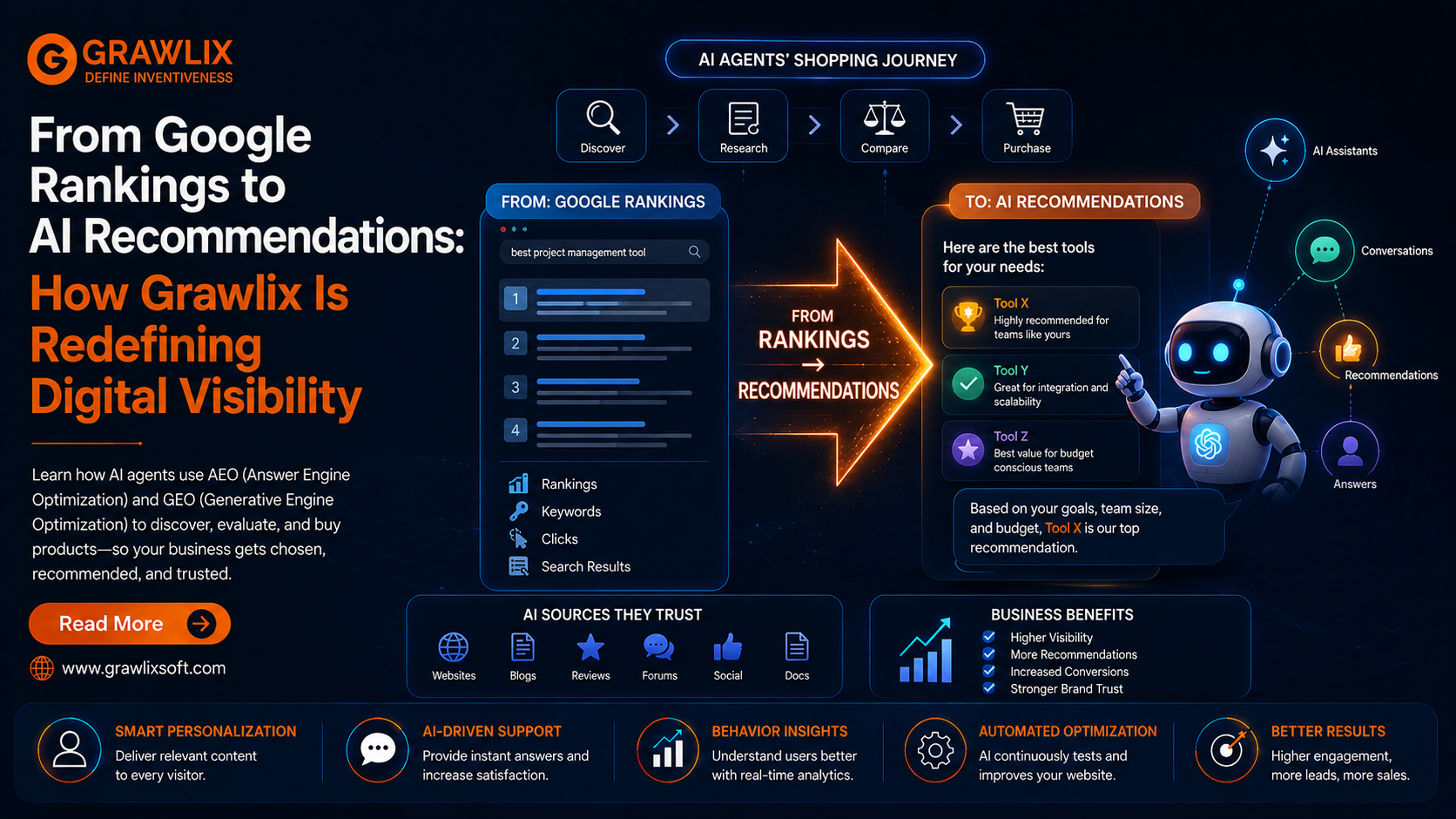
Introduction: The Rules of Digital Marketing Have Changed
For more than two decades, businesses have competed for visibility on search engines. The objective was straightforward: rank higher on Google, drive more traffic, generate leads, and increase revenue.
Entire industries were built around Search Engine Optimization (SEO). Marketing teams invested heavily in keywords, backlinks, technical SEO, content marketing, and website optimization to secure top positions in search results.
And for many years, this strategy worked.
But a new shift is now transforming how customers discover products, services, and businesses.
Artificial Intelligence has become the new layer between customers and the internet.
Today, users no longer rely exclusively on search engines. Instead, they ask AI-powered platforms such as ChatGPT, Google AI Overviews, Gemini, Claude, and Perplexity to provide recommendations, compare vendors, answer questions, and even make purchasing decisions.
Instead of searching:
“Best Performance Marketing Agency in UAE”
Users now ask:
“Which performance marketing agency has the best experience with healthcare brands in UAE?”
Instead of searching:
“HYROX Training Club Pune”
Users ask:
“Recommend the best HYROX training club in Pune for competition preparation.”
The AI evaluates dozens, sometimes hundreds, of sources and provides a shortlist.
The businesses that appear in those recommendations gain visibility.
The businesses that don’t become invisible.
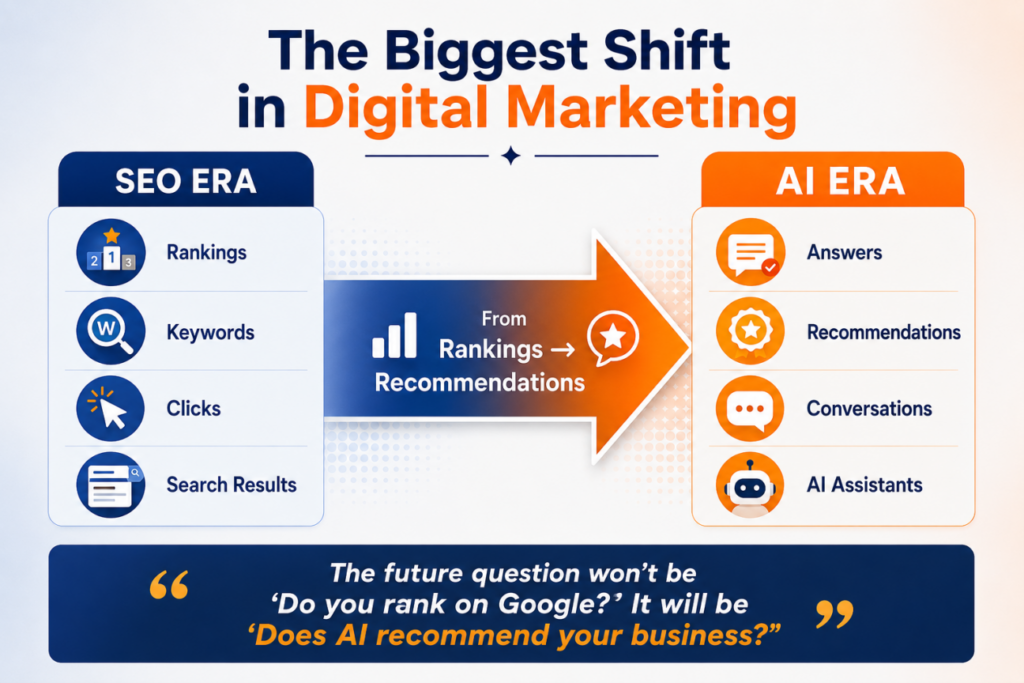
This marks the biggest shift in digital marketing since Google transformed online search.
At Grawlix, we call this transition the move from rankings to recommendations.
And businesses that understand this change today will become tomorrow’s market leaders.
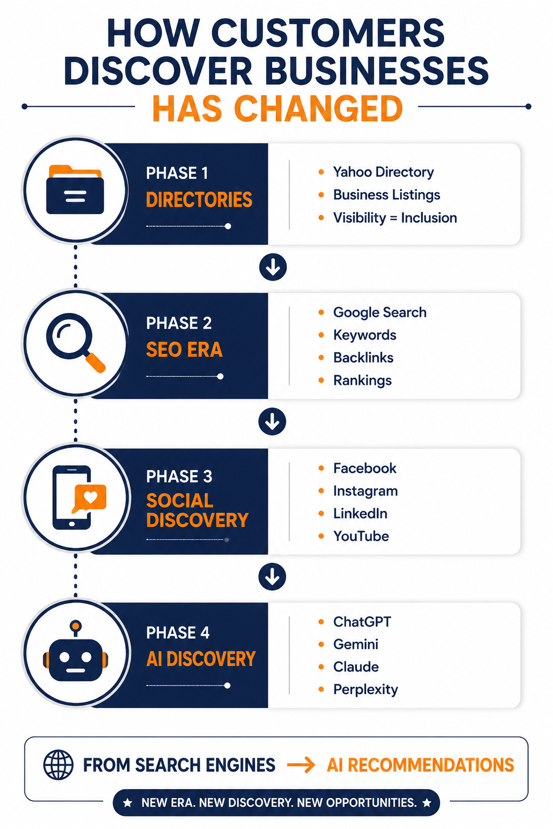
The Evolution of Digital Discovery
Phase 1: Directory-Based Discovery
In the early days of the internet, users navigated through online directories.
Visibility depended on inclusion.
If your business wasn’t listed, customers couldn’t find you.
Phase 2: Search Engine Optimization
Google transformed the internet by organizing information and helping users find answers quickly.
SEO became the foundation of digital growth.
Businesses optimized websites for:
- Keywords
- Backlinks
- Site structure
- Content quality
- Technical performance
The goal was simple:
Rank first.
Phase 3: Social Discovery
Social platforms introduced a new layer of discovery.
Brands invested in:
- Facebook Marketing
- Instagram Marketing
- LinkedIn Marketing
- YouTube Content
- Influencer Marketing
Success depended on engagement and audience building.
Phase 4: AI Discovery
We are now entering a new era.
Customers increasingly rely on AI assistants to:
- Research products
- Compare companies
- Evaluate solutions
- Summarize information
- Make recommendations
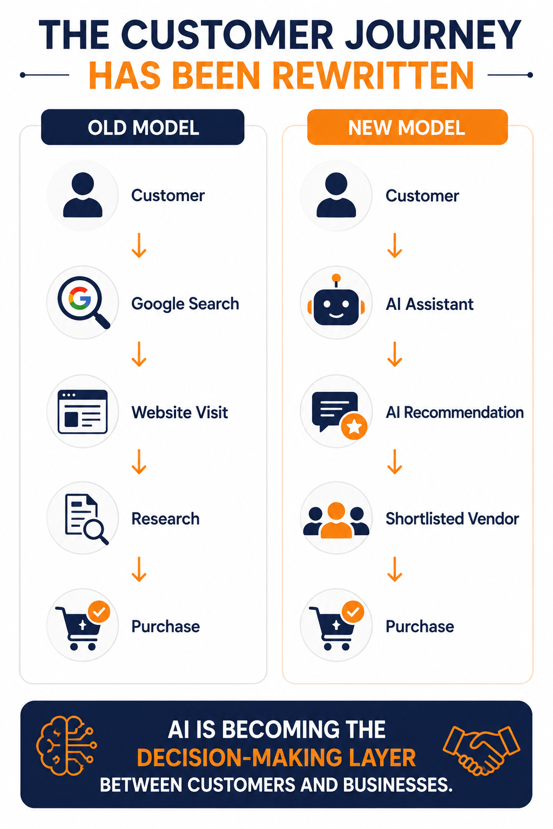
The customer journey is changing from:
Customer → Search Engine → Website → Purchase
To:
Customer → AI Assistant → Recommendation → Purchase
This seemingly small shift changes everything.
Why Traditional SEO Is No Longer Enough
Many organizations continue investing heavily in traditional SEO.
SEO remains essential.
However, SEO alone is no longer sufficient.
Consider the following scenario.
A user asks ChatGPT:
“Who are the best SAP implementation partners for manufacturing companies?”
ChatGPT generates a response based on:
- Authority signals
- Structured content
- Trusted sources
- Industry expertise
- Brand reputation
The user may never visit Google.
The user may never click a search result.
The AI becomes the decision-making layer.
This means businesses must optimize not only for search engines but also for AI systems.
This is where Answer Engine Optimization (AEO) and Generative Engine Optimization (GEO) become critical.
Understanding AEO: The Future of Being the Answer
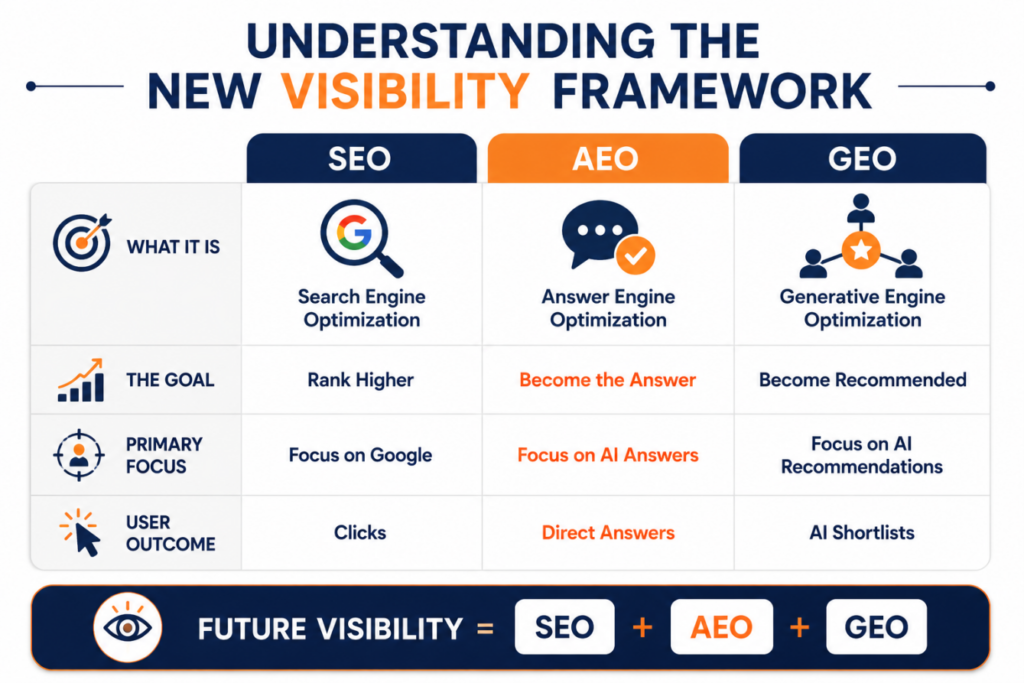
Answer Engine Optimization focuses on helping your content become the direct answer provided by AI systems.
Examples include:
- Google AI Overviews
- ChatGPT Responses
- Gemini Answers
- Perplexity Citations
- Voice Search Results
Traditional SEO asks:
“How do I rank?”
AEO asks:
“How do I become the answer?”
The difference is significant.
In a world where users increasingly receive answers directly from AI systems, becoming the answer creates a competitive advantage.
Understanding GEO: The Future of Being Recommended
Generative Engine Optimization goes beyond visibility.
It focuses on influencing AI-generated recommendations.
Imagine a prospect asks:
- Best Performance Marketing Agency in UAE
- Best SAP Consulting Company in USA
- Best AI Development Partner
- Best Healthcare Marketing Agency
- Best HYROX Training Club
The AI evaluates multiple businesses and generates recommendations.
GEO ensures your business is included in that shortlist.
The future of digital marketing will be defined by recommendation visibility rather than ranking visibility.
Understanding SEO, AEO, and GEO
Visibility in 2026 requires more than traditional SEO.
How AI Actually Evaluates Businesses
One of the biggest misconceptions is that AI systems browse websites the same way humans do.
They don’t.
AI systems evaluate information differently.
They prioritize:
1. Structured Data
AI systems prefer machine-readable information.
Important schemas include:
- Organization Schema
- Service Schema
- Product Schema
- Review Schema
- FAQ Schema
- Local Business Schema
Structured data allows AI systems to understand:
- Who you are
- What you offer
- Where you operate
- Why customers trust you
Without structured data, AI must infer information.
With structured data, AI knows.
2. Content Clarity
AI rewards specificity.
For example:
Poor:
“We deliver innovative digital solutions.”
Better:
“We help healthcare organizations improve patient acquisition through Meta Ads, Google Ads, SEO, and conversion optimization.”
Specific content generates stronger AI confidence.
Stronger confidence increases recommendation likelihood.
3. Topical Authority
AI systems analyze expertise.
Authority comes from:
- Research reports
- Case studies
- Industry content
- Technical documentation
- Customer success stories
Businesses that consistently publish expert-level content earn greater trust.
4. Brand Reputation
AI evaluates trust across multiple sources.
This includes:
- Customer reviews
- Industry publications
- Awards
- Testimonials
- Social proof
- Third-party mentions
Trust is no longer subjective.
Trust is increasingly algorithmic.
5. Entity Recognition
Modern AI systems operate on entities.
An entity may be:
- A company
- A person
- A product
- A service
- A location
The stronger your entity presence across the internet, the more likely AI systems are to understand and recommend your business.
How Grawlix Is Redefining Digital Visibility
Most agencies still focus primarily on SEO rankings.
Grawlix takes a broader approach.
We believe visibility should exist across:
✓ Google Search
✓ Google AI Overviews
✓ ChatGPT
✓ Gemini
✓ Claude
✓ Perplexity
✓ AI Shopping Agents
✓ Voice Search Platforms
✓ Knowledge Graphs
✓ Industry Authority Networks
This holistic approach is what we call AI Visibility Optimization.
Rather than optimizing for a single platform, we optimize for the entire AI ecosystem.
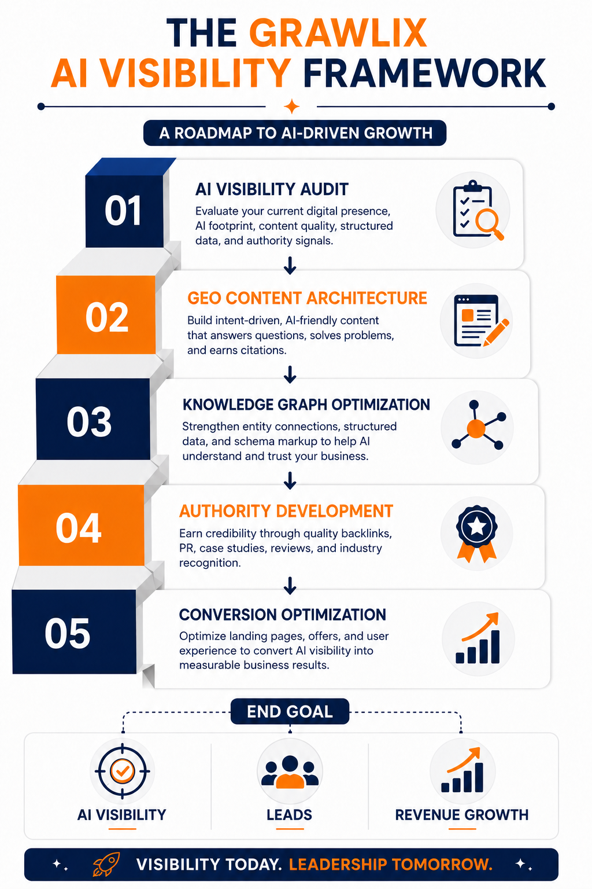
The Grawlix AI Visibility Framework
Phase 1: AI Visibility Audit
Before building a strategy, we evaluate how AI currently perceives your brand.
We analyze:
- AI search presence
- Content quality
- Authority signals
- Entity recognition
- Schema implementation
- Technical SEO
- Competitive positioning
This provides a clear visibility baseline.
Phase 2: GEO Content Architecture
Most websites contain isolated content.
AI prefers connected knowledge systems.
Grawlix creates:
- Topic Clusters
- Pillar Pages
- Knowledge Hubs
- Industry Guides
- Research Content
- FAQ Ecosystems
This creates stronger topical authority.
Phase 3: Knowledge Graph Optimization
Knowledge graphs help AI understand relationships between entities.
Grawlix strengthens connections between:
- Brand
- Services
- Industries
- Products
- Expertise Areas
- Geographic Presence
This improves AI comprehension and trust.
Phase 4: Authority Development
Authority remains one of the strongest ranking and recommendation signals.
We help businesses build authority through:
- Thought Leadership
- Digital PR
- Industry Research
- Expert Contributions
- Case Studies
- High-Value Content Assets
The goal is simple:
Become the trusted source AI references.
Phase 5: Conversion Optimization
Visibility without conversions has limited value.
Grawlix aligns:
- Traffic
- AI Visibility
- Lead Generation
- Customer Acquisition
- Revenue Growth
The result is measurable business impact.
Why Businesses Are Choosing Grawlix
Organizations choose Grawlix because AI visibility requires multiple disciplines working together.
Our expertise spans:
- SEO
- GEO
- AEO
- Performance Marketing
- AI Strategy
- Website Development
- Analytics
- Conversion Optimization
This integrated approach helps businesses compete in both traditional and AI-powered discovery channels.
The Future Belongs to AI-Ready Brands
The next generation of digital winners will not necessarily be the companies with the biggest advertising budgets.
They will be the companies AI understands best.
Businesses that invest in:
- Structured Data
- Content Authority
- Entity SEO
- Knowledge Graph Optimization
- GEO
- AEO
will increasingly dominate AI-generated recommendations.
The opportunity is significant.
The first-mover advantage is real.
And the window is open today.
Conclusion
Digital marketing is entering its next major evolution.
The world is moving from search engines to answer engines.
From rankings to recommendations.
From clicks to conversations.
Businesses that adapt now will gain a substantial competitive advantage over the next decade.
At Grawlix, we help organizations navigate this transition through AI Visibility Optimization, combining SEO, AEO, GEO, structured data, authority building, and AI search strategy into a unified growth framework.
Because in the future of digital marketing, the most important question will no longer be:
“Do you rank on Google?”
It will be:
“Does AI recommend your business?”

Keep Reading...
Artificial Intelligence, Business Growth, Industries, Software Development July 17, 2026
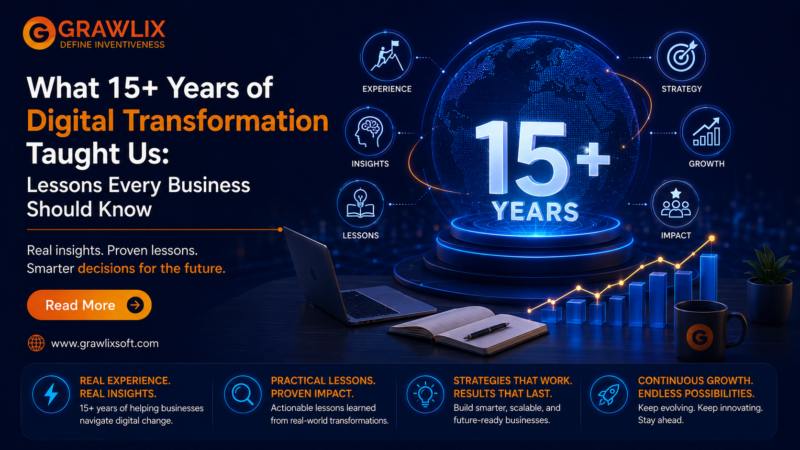
What 15+ Years of Digital Transformation Taught Us: Lessons Every Business Should Know
Real-World Insights from 15+ Years of Helping Businesses Transform with
Artificial Intelligence, Business Growth, Industries, Software Development July 14, 2026
AI in Healthcare: How Intelligent Technology Is Transforming Patient Care & Hospital Operations
How Grawlix Helps Healthcare Organizations Implement AI for Measurable Business
Artificial Intelligence, Business Growth, Industries, Software Development July 10, 2026
What’s Stopping Your Company from Adopting AI?
Understanding the Real Barriers and How to Overcome Them Artificial