
Artificial Intelligence, Business Growth, Pricing Strategy, Software Development
AI Agents Are Already Shopping for Your Customers: The Complete AEO & GEO Guide for Businesses in 2026

Introduction: The Biggest Shift Since Google Search
For more than 25 years, businesses have relied on search engines to connect with customers. The formula was relatively simple: build a website, optimize it for search engines, rank on Google, generate traffic, and convert visitors into customers.
Today, that formula is being disrupted.
Artificial Intelligence is changing how people discover products, evaluate services, and make purchasing decisions. Instead of manually searching dozens of websites, comparing options, reading reviews, and evaluating businesses, consumers are increasingly asking AI assistants to do the work for them.
Consider these queries:
- “Find me the best SAP implementation partner in the USA.”
- “Recommend the best performance marketing agency for healthcare companies.”
- “What is the best HYROX training club in Pune?”
- “Compare the top AI consulting firms for manufacturing businesses.”
Previously, users would visit multiple websites and conduct their own research.
Now, AI systems perform much of that research automatically.
Platforms such as ChatGPT, Google AI Overviews, Gemini, Claude, Perplexity, and emerging AI shopping agents are becoming the new gatekeepers between businesses and customers.
This creates a critical question:
Can AI understand your business well enough to recommend it?
If the answer is no, your competitors may win customers before prospects ever see your website.
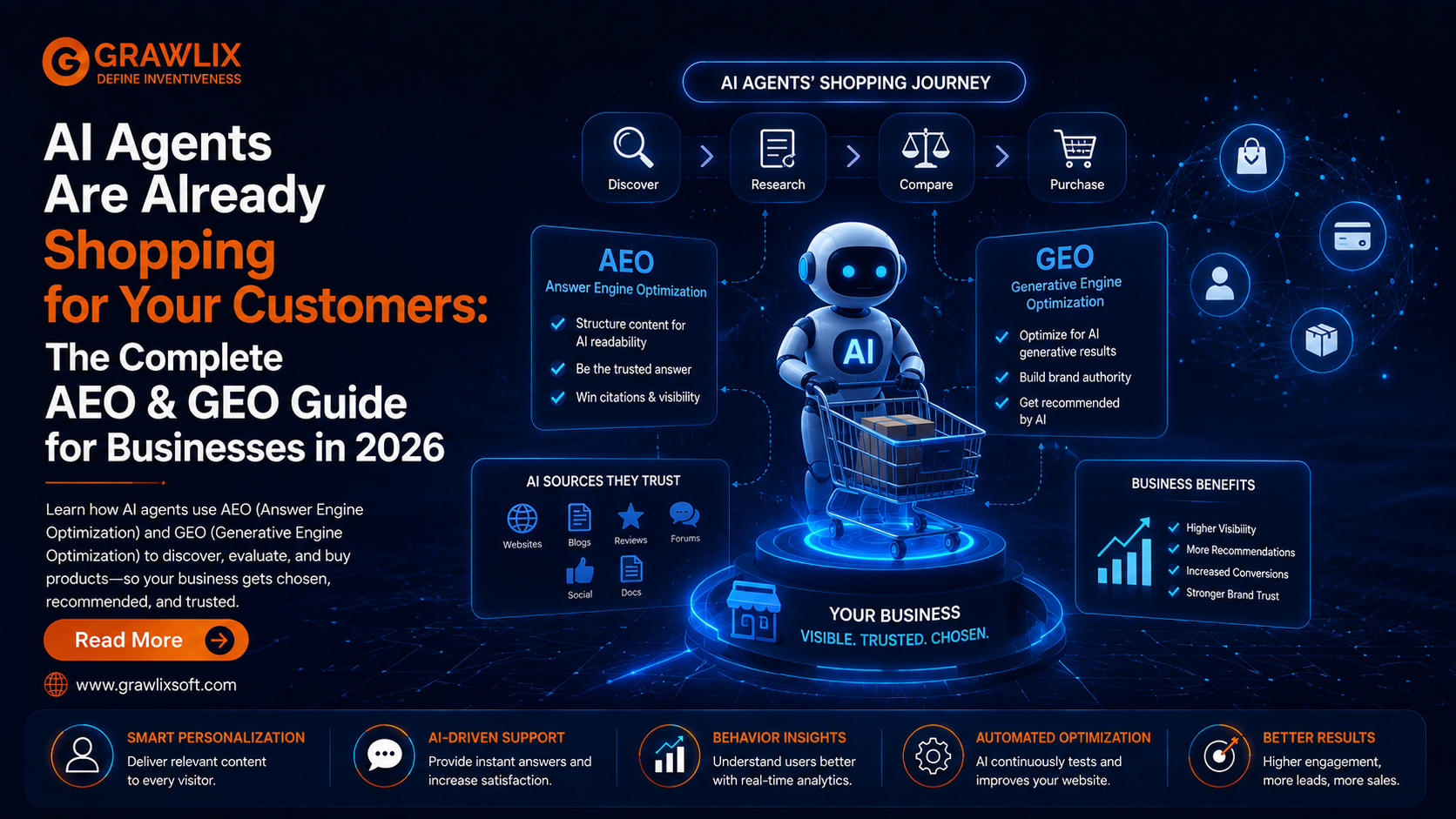
This is why AEO (Answer Engine Optimization) and GEO (Generative Engine Optimization) are rapidly becoming essential business strategies.
The Internet Has Entered a New Era
Every major shift in internet behavior has created winners and losers.
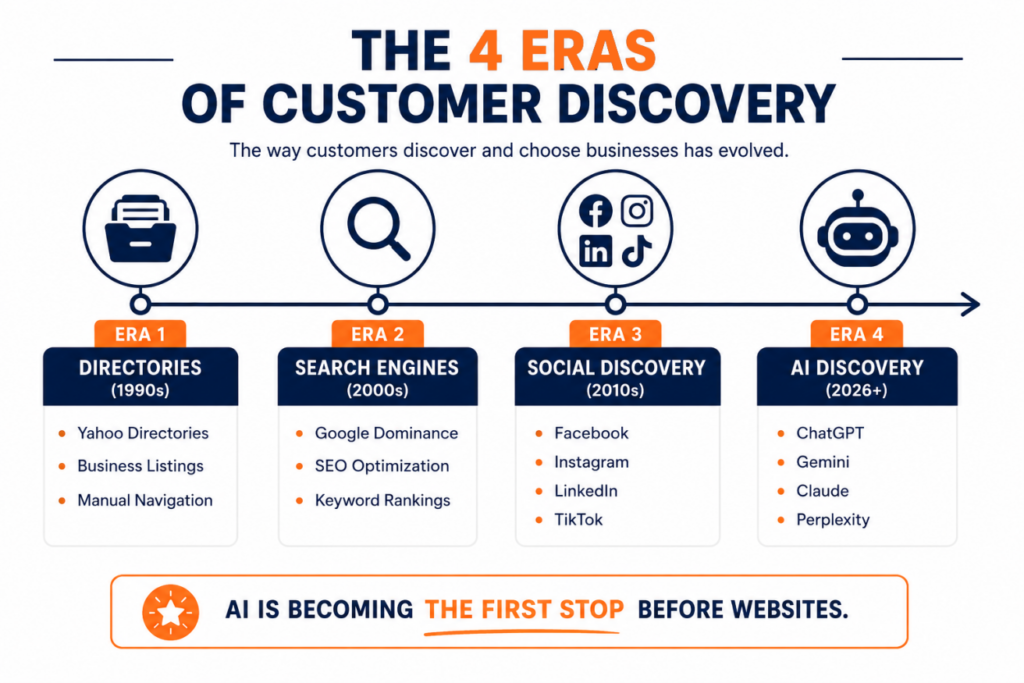
Era 1: Directory-Based Discovery
In the early days of the internet, users navigated websites through directories.
Businesses that secured directory listings gained visibility.
Era 2: Search Engine Dominance
Google revolutionized online discovery.
Websites optimized for SEO dominated traffic.
Keywords became digital real estate.
Companies invested billions in ranking higher on search engines.
Era 3: Social Media Discovery
Facebook, Instagram, LinkedIn, YouTube, and TikTok became major discovery platforms.
Brands shifted budgets toward social content and audience engagement.
Era 4: AI-Assisted Discovery
We are now entering a world where AI becomes the primary discovery layer.
Instead of searching manually, users increasingly ask:
- “What’s the best option?”
- “Compare providers.”
- “Which company should I choose?”
- “Find the most affordable solution.”
The AI gathers information, evaluates options, and provides recommendations.
The customer often accepts the shortlist generated by AI.
This means businesses must optimize not only for humans but also for AI systems.
Understanding the New Customer Journey
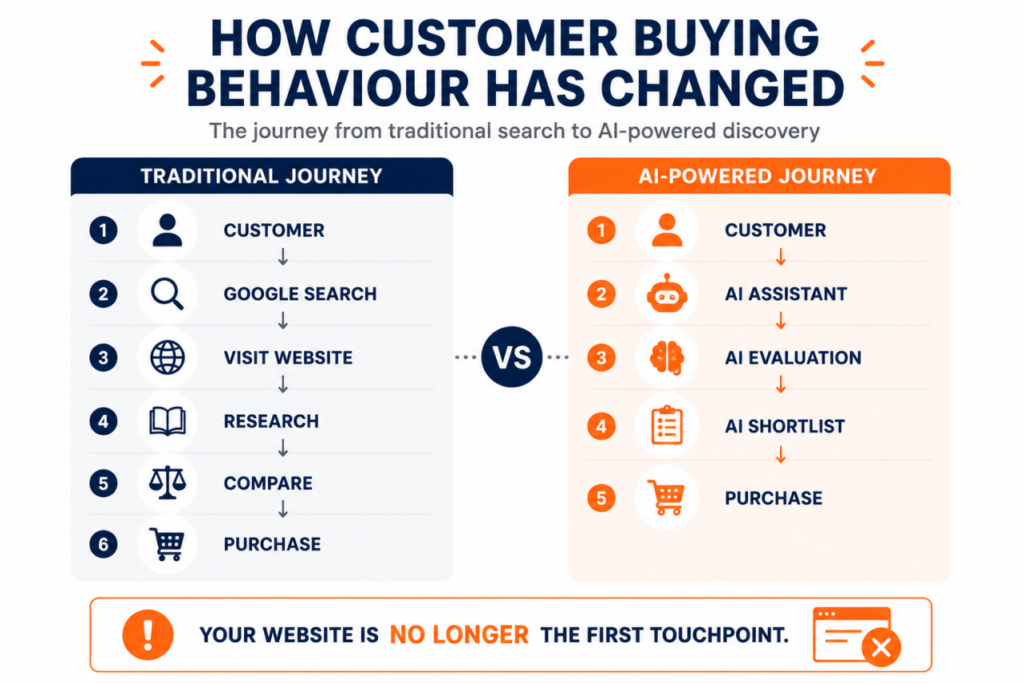
Traditional Customer Journey
Customer → Google Search → Website → Research → Comparison → Decision → Purchase
In this model, your website had an opportunity to persuade visitors.
Good design, persuasive copy, testimonials, and offers influenced buying decisions.
AI-Powered Customer Journey
Customer → AI Assistant → AI Evaluation → AI Shortlist → Decision → Purchase
Notice something important:
The website is no longer the first touchpoint.
AI becomes the first evaluator.
Before a human visits your website, AI has already decided whether your business deserves consideration.
This changes everything.
Businesses now compete not only for human attention but also for AI visibility.
How AI Agents Actually Evaluate Businesses
Most business owners incorrectly assume AI reads websites the same way humans do.
It does not.
AI systems prioritize machine-readable information.
They analyze patterns, relationships, trust indicators, and structured data.
Their goal is to answer questions accurately and confidently.
To do this, they evaluate several categories of information.
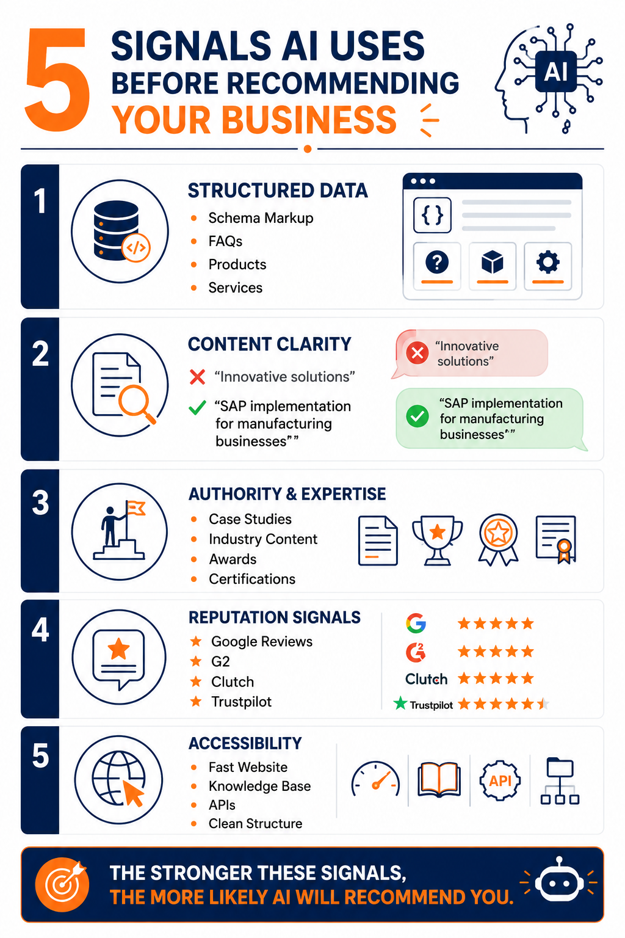
Signal #1: Structured Data
Structured data acts as a language AI systems can understand.
Schema markup helps AI interpret:
- Business details
- Products
- Services
- Reviews
- FAQs
- Articles
- Locations
Without structured data, AI must infer information.
With structured data, AI receives explicit information.
Essential Schema Types
Organization Schema
Defines:
- Business name
- Logo
- Website
- Contact details
- Social profiles
Local Business Schema
Important for local visibility.
Includes:
- Address
- Phone number
- Operating hours
- Geographic information
Service Schema
Helps AI understand:
- Services offered
- Industries served
- Benefits provided
Product Schema
Critical for ecommerce businesses.
Includes:
- Pricing
- Availability
- Reviews
- Features
FAQ Schema
One of the most effective schema implementations for AEO.
Helps AI extract direct answers.
Signal #2: Content Clarity
AI systems reward clarity over cleverness.
Many websites use vague language such as:
“We provide innovative solutions that transform businesses.”
This statement sounds impressive but communicates nothing.
AI prefers statements like:
“We help manufacturing companies implement SAP S/4HANA and reduce supply chain inefficiencies through automation.”
Specificity creates confidence.
Confidence drives recommendations.
Signal #3: Authority and Expertise
AI systems evaluate whether your business demonstrates genuine expertise.
This concept aligns closely with Google’s E-E-A-T framework:
Experience
Have you actually done the work?
Examples:
- Case studies
- Project portfolios
- Customer outcomes
Expertise
Do you possess deep knowledge?
Examples:
- Industry guides
- Technical documentation
- Research papers
Authoritativeness
Are you recognized by others?
Examples:
- Media mentions
- Industry awards
- Guest contributions
Trustworthiness
Can users rely on your information?
Examples:
- Transparent pricing
- Verified reviews
- Security certifications
AI systems increasingly prioritize businesses with strong E-E-A-T signals.
Signal #4: Reputation Signals
AI does not rely on a single source.
It aggregates trust across the internet.
Sources include:
- Google Reviews
- Trustpilot
- Clutch
- G2
- Industry directories
- Social mentions
- News publications
Businesses with consistent positive reputation signals gain stronger visibility.
This is one reason why review management is becoming an AEO strategy rather than simply a customer service initiative.
Signal #5: Accessibility of Information
AI agents prefer businesses that make information easy to consume.
This includes:
- Fast-loading websites
- Clean architecture
- Structured content
- APIs
- Knowledge bases
The easier your information is to process, the more likely AI systems can use it.
Why Traditional SEO Alone Is No Longer Enough
SEO remains important.
However, ranking first on Google no longer guarantees visibility.
Consider a user asking:
“Who are the best SAP implementation companies in the USA?”
Google AI Overview may provide an answer directly.
ChatGPT may generate a recommendation.
Perplexity may summarize multiple sources.
The user may never click a search result.
This is where GEO becomes critical.
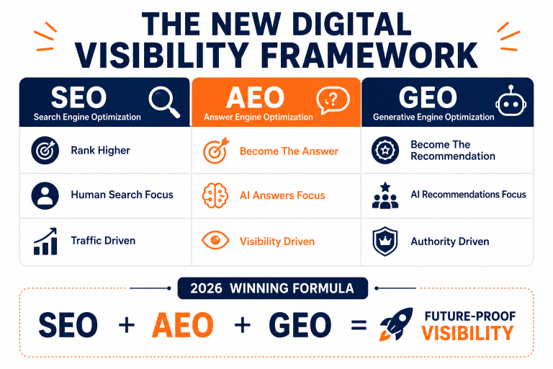
What Is Generative Engine Optimization (GEO)?
Generative Engine Optimization is the practice of optimizing content so AI systems reference, cite, and recommend your business in generated responses.
Traditional SEO focuses on rankings.
GEO focuses on recommendations.
SEO asks:
“How do I rank?”
GEO asks:
“How do I become the answer?”
This distinction is crucial.
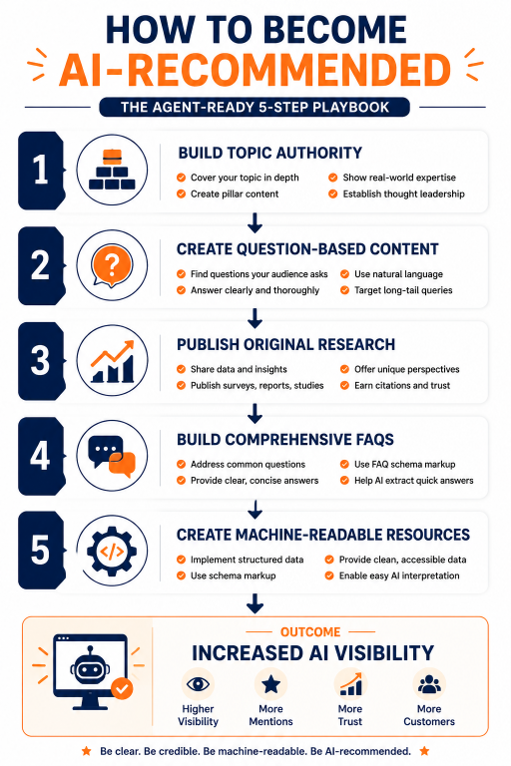
The Five-Step Agent-Ready Playbook
Step 1: Build Topic Authority Clusters
Create comprehensive content around core business topics.
For example:
Performance Marketing Agency
Create content covering:
- Meta Advertising
- Google Ads
- Conversion Rate Optimization
- Attribution Modeling
- Marketing Analytics
- Customer Acquisition
The deeper your content ecosystem, the more authority AI assigns to your business.
Step 2: Create Question-Based Content
AI systems love questions.
Examples:
- What is GEO?
- What is AEO?
- How does AI search work?
- How do AI agents choose businesses?
- What is the future of SEO?
Question-based content significantly improves AI visibility.
Step 3: Publish Original Research
Original data is one of the strongest authority signals available.
Examples:
- Industry benchmarks
- Customer surveys
- Market reports
- Performance studies
AI systems frequently reference unique insights.
Step 4: Develop Comprehensive FAQs
FAQ sections help AI extract precise answers.
Each service page should include:
- Pricing questions
- Process questions
- Timeline questions
- Comparison questions
- Industry-specific questions
This increases eligibility for AI-generated answers.
Step 5: Create Machine-Readable Resources
The future belongs to businesses that expose structured information.
Examples include:
- APIs
- Product feeds
- Service catalogs
- Knowledge graphs
These resources allow AI systems to consume information efficiently.
Industries That Will Benefit First
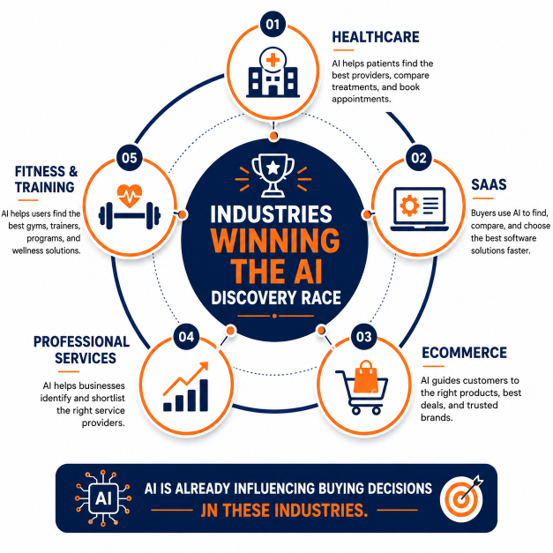
Several industries are already seeing AI-driven buying behavior.
Healthcare
Patients increasingly ask AI about:
- Providers
- Treatments
- Clinics
SaaS
Software buyers use AI to compare tools.
Ecommerce
AI shopping agents are rapidly growing.
Professional Services
Consulting firms, agencies, and implementation partners will compete heavily for AI recommendations.
Fitness & Training
Users increasingly ask:
- Best gym near me
- Best HYROX training club
- Best personal trainer
AI-generated recommendations influence decisions.
The First-Mover Advantage
Every major technology shift rewards early adopters.
SEO rewarded businesses that optimized websites early.
Social media rewarded brands that built audiences early.
Mobile optimization rewarded businesses that adapted quickly.
AEO and GEO present a similar opportunity.
Businesses implementing AI optimization today face relatively little competition.
In 24–36 months, competition will be dramatically higher.
Those who establish authority now will enjoy compounding visibility.
Future Prediction: AI Will Become the Primary Buyer Assistant
Within the next few years, AI agents will:
- Compare vendors automatically
- Negotiate pricing
- Evaluate proposals
- Schedule meetings
- Recommend purchases
The companies that make information easiest to understand and verify will dominate these recommendations.
This is why AEO and GEO are no longer optional.
They represent the next evolution of digital marketing.
Final Thoughts
The future of customer acquisition is not just about ranking in search engines.
It is about becoming the most trusted, machine-readable, and authoritative source in your industry.
Businesses that optimize for AI today will be recommended tomorrow.
Those recommendations will increasingly influence:
- Lead generation
- Ecommerce sales
- Service inquiries
- Brand visibility
- Market share
The opportunity is significant.
The window is open.
But it will not remain open forever.
The businesses investing in AEO and GEO now are positioning themselves to become the default recommendations of AI systems for years to come.
Key Takeaways
✓ AI agents are already influencing buying decisions
✓ Websites must be optimized for both humans and AI systems
✓ Structured data is becoming a competitive advantage
✓ Authority, expertise, and trust signals matter more than ever
✓ GEO focuses on becoming the recommendation, not just ranking
✓ AEO helps your content become the answer in AI-generated results
✓ Early adopters will gain disproportionate visibility in AI search
✓ The future belongs to businesses that are AI-readable, trustworthy, and authoritative
Keep Reading...
Artificial Intelligence, Business Growth, Industries, Software Development July 17, 2026
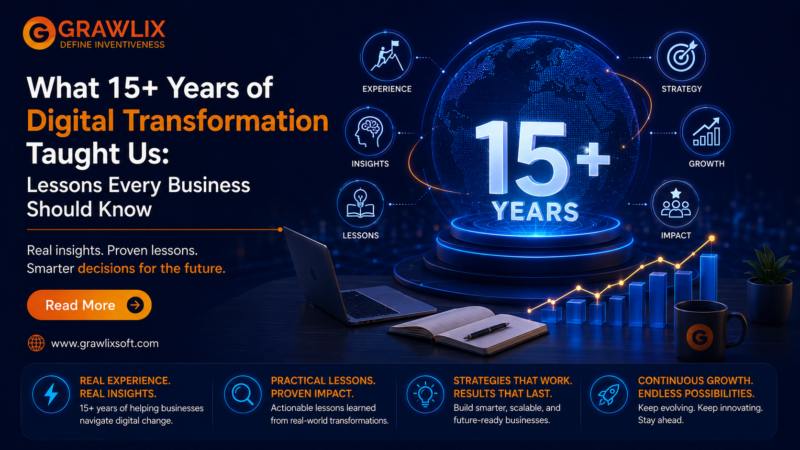
What 15+ Years of Digital Transformation Taught Us: Lessons Every Business Should Know
Real-World Insights from 15+ Years of Helping Businesses Transform with
Artificial Intelligence, Business Growth, Industries, Software Development July 14, 2026
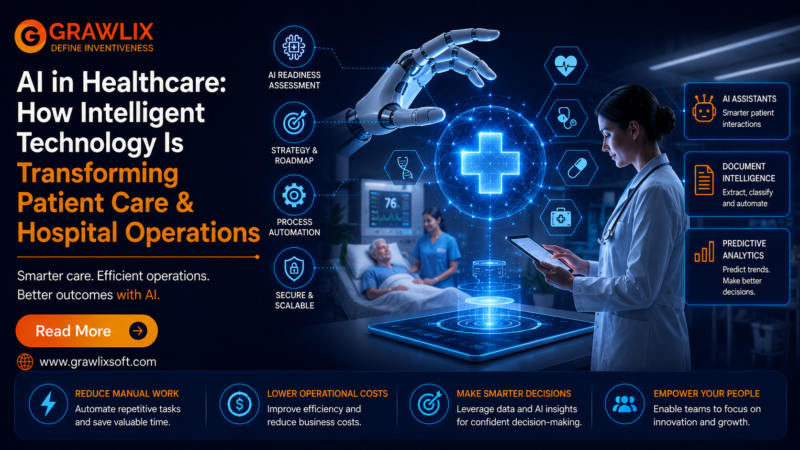
AI in Healthcare: How Intelligent Technology Is Transforming Patient Care & Hospital Operations
How Grawlix Helps Healthcare Organizations Implement AI for Measurable Business
Artificial Intelligence, Business Growth, Industries, Software Development July 10, 2026
What’s Stopping Your Company from Adopting AI?
Understanding the Real Barriers and How to Overcome Them Artificial