
Artificial Intelligence, Business Growth, Pricing Strategy, Software Development
How AI Improves Pricing Strategies in E-Commerce

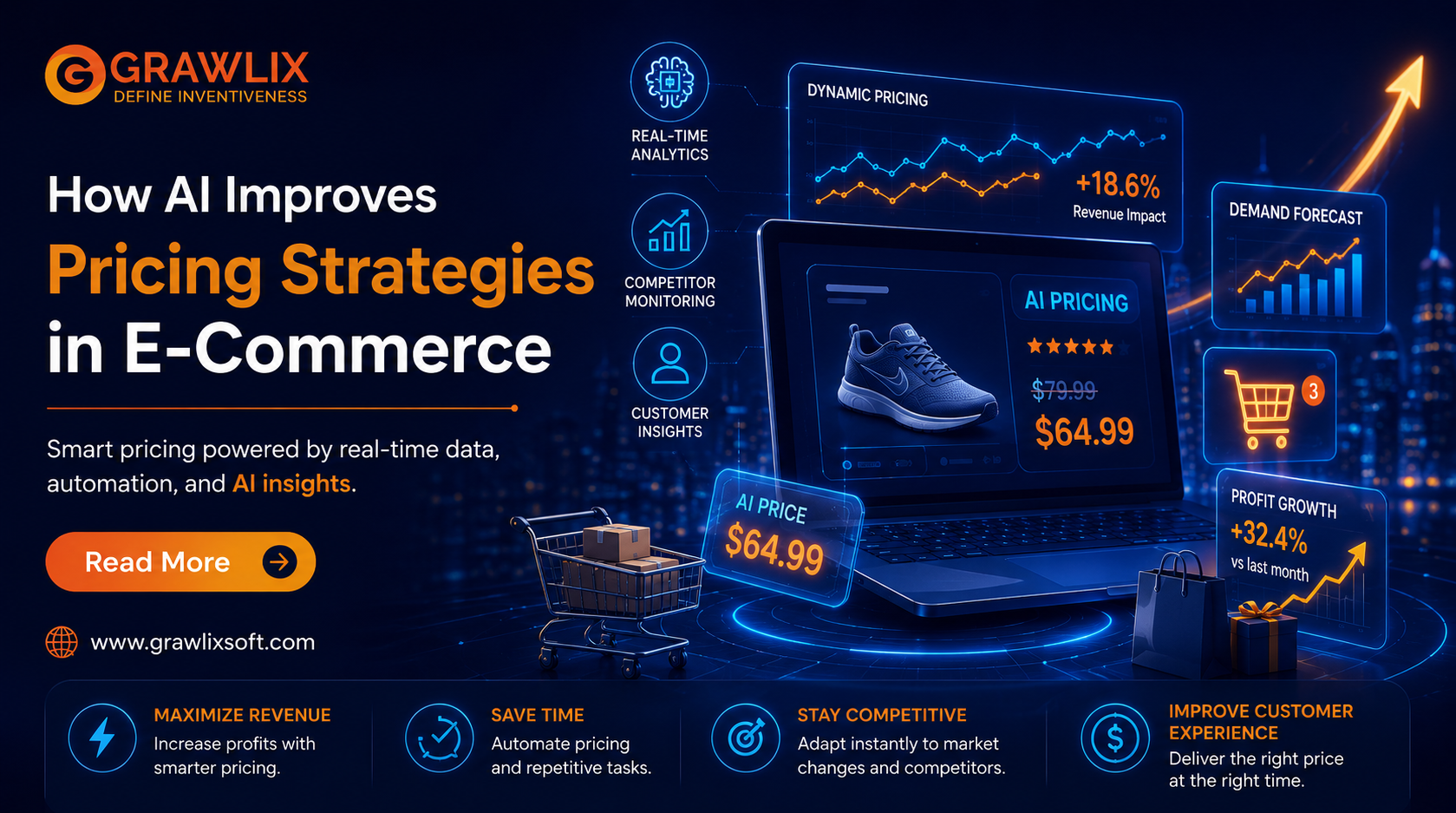
In today’s highly competitive e-commerce landscape, pricing is no longer just about setting a number and hoping customers buy. Consumer behavior changes rapidly, competitors update prices constantly, and market demand fluctuates every hour. Businesses that rely on static pricing strategies often struggle to stay profitable while maintaining customer trust.
This is where Artificial Intelligence (AI) is revolutionizing e-commerce pricing strategies.
AI-powered pricing systems analyze massive amounts of real-time data, helping businesses make smarter pricing decisions automatically. From predicting customer demand to adjusting prices dynamically based on competitor activity, AI allows online stores to maximize revenue while improving customer satisfaction.
For modern e-commerce brands, AI pricing is no longer a luxury — it’s becoming a competitive necessity.
What is AI-Based Pricing in E-Commerce?
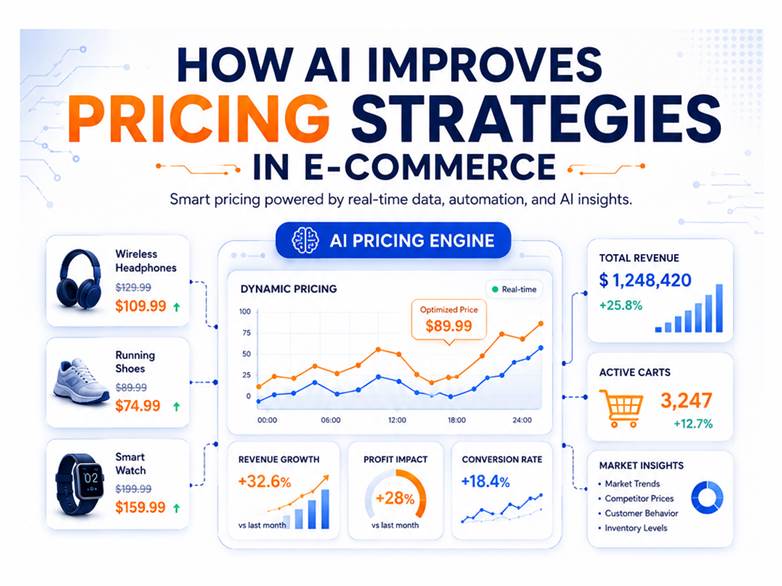
AI-based pricing refers to the use of machine learning algorithms and data analytics to determine the most effective product prices in real time.
Instead of relying solely on manual pricing decisions, AI systems evaluate multiple factors such as:
- Customer behavior
- Competitor pricing
- Demand fluctuations
- Seasonal trends
- Inventory levels
- Purchase history
- Market conditions
- Product popularity
Using this data, AI can recommend or automatically implement optimal pricing strategies that improve both profitability and conversions.
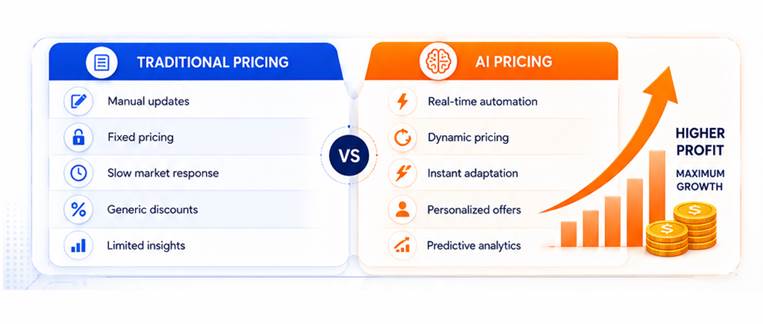
Why Traditional Pricing Strategies No Longer Work
Many businesses still use outdated pricing methods such as:
- Fixed pricing
- Cost-plus pricing
- Manual competitor checks
- Seasonal discounts only
While these methods worked in the past, modern e-commerce markets move far too quickly for manual pricing decisions.
Traditional pricing challenges include:
Slow Market Response
Competitors may change prices several times a day, making manual adjustments ineffective.
Missed Revenue Opportunities
Businesses often underprice products during high demand periods.
Overstock Problems
Without demand prediction, businesses struggle to clear inventory efficiently.
Reduced Profit Margins
Price wars can force companies into unhealthy discounting.
AI helps solve these challenges by continuously learning and adapting pricing strategies automatically.
How AI Improves Pricing Strategies
1. Dynamic Pricing in Real Time
One of the biggest advantages of AI is dynamic pricing.
AI systems can automatically adjust prices based on:
- Demand spikes
- Competitor changes
- Time of day
- Product availability
- Customer activity
For example, if a product suddenly becomes highly popular, AI can slightly increase the price to improve margins without reducing sales significantly.
Similarly, during low demand periods, AI may reduce prices strategically to encourage conversions.
This helps businesses stay competitive while maximizing profitability.
2. Competitor Price Monitoring
AI tools continuously monitor competitor pricing across multiple platforms.
Instead of manually checking competitor websites, AI systems can:
- Track price changes instantly
- Identify market pricing trends
- Suggest optimal pricing positions
- Prevent unnecessary underpricing
This enables businesses to react quickly while protecting profit margins.
For example, if competitors reduce prices aggressively, AI may recommend bundle offers instead of direct discounts to maintain perceived value.
3. Demand Forecasting
AI excels at predictive analytics.
By studying historical sales data, customer behavior, and seasonal patterns, AI can predict future demand with impressive accuracy.
Benefits include:
- Better inventory planning
- Improved promotional timing
- Reduced overstocking
- Optimized pricing during peak demand
For example, AI may detect rising demand for fitness products before New Year’s resolutions begin, allowing businesses to increase prices strategically while preparing inventory.
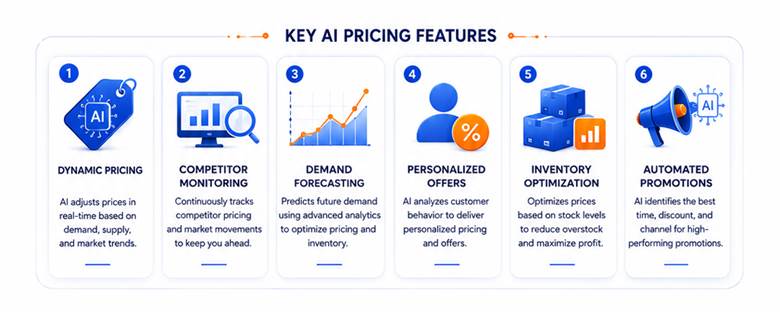
4. Personalized Pricing and Offers
Modern consumers expect personalized shopping experiences.
AI helps businesses create customized pricing strategies based on:
- User browsing behavior
- Purchase history
- Loyalty status
- Cart abandonment patterns
- Geographic location
Instead of offering blanket discounts to everyone, businesses can provide targeted offers to specific customer segments.
Examples include:
- Personalized discount coupons
- VIP pricing
- First-time buyer offers
- Dynamic bundle recommendations
This increases conversion rates while protecting overall profitability.
5. Inventory-Based Pricing Optimization
Inventory management and pricing are deeply connected.
AI can adjust prices according to stock levels.
High Inventory
AI may suggest limited-time discounts to increase sales velocity.
Low Inventory
AI may raise prices slightly to maximize margins while inventory lasts.
This helps businesses maintain healthier cash flow and reduce dead stock problems.
6. Customer Behavior Analysis
AI analyzes customer interactions in real time to identify buying patterns.
It studies:
- Click behavior
- Product views
- Time spent on pages
- Purchase timing
- Abandoned carts
This data helps businesses understand pricing sensitivity.
For example, if customers consistently abandon carts after price increases, AI can identify the optimal price threshold that balances conversions and profits.
7. Automated Promotional Strategies
AI can automate promotions based on customer demand and business goals.
Instead of running random discounts, AI can determine:
- Best discount percentages
- Ideal timing for sales
- Most effective product bundles
- Campaign profitability predictions
This creates smarter marketing campaigns with better ROI.
Benefits of AI Pricing Strategies
Increased Revenue
AI identifies pricing opportunities that maximize profit margins without hurting sales.
Faster Decision-Making
Real-time automation eliminates slow manual pricing processes.
Improved Customer Experience
Customers receive more relevant pricing and offers.
Better Competitive Positioning
Businesses can respond instantly to market changes.
Smarter Inventory Management
AI helps balance pricing with inventory demand.
Reduced Human Errors
Automated systems minimize pricing mistakes and inconsistencies.
Industries Already Using AI Pricing Successfully
Many major brands already use AI pricing strategies extensively.
Examples include:
- Online retail stores
- Airline ticket platforms
- Hotel booking websites
- Food delivery apps
- Ride-sharing platforms
- Electronics marketplaces
Dynamic pricing has become standard practice for many digital-first businesses.
Challenges Businesses Should Consider
Although AI pricing offers huge benefits, businesses should implement it carefully.
Pricing Transparency
Frequent price changes can confuse customers if not managed properly.
Data Quality
AI systems depend heavily on accurate and clean data.
Customer Trust
Extreme price fluctuations may damage brand reputation.
Integration Complexity
AI pricing tools must integrate smoothly with existing e-commerce systems.
A balanced strategy combining AI automation with human oversight usually works best.
How Grawlix Helps Businesses Build AI-Driven E-Commerce Systems
At Grawlix, businesses can implement advanced AI-powered solutions that improve pricing, automation, analytics, and customer engagement.
Grawlix helps e-commerce brands with:
- AI-powered pricing systems
- Smart automation tools
- Customer behavior analytics
- Custom e-commerce platforms
- Real-time dashboards
- Conversion optimization
- AI-integrated CRM systems
By combining technology, marketing, and business intelligence, Grawlix helps brands scale faster while improving operational efficiency.
The Future of AI Pricing in E-Commerce
AI pricing systems will continue becoming more advanced over the next few years.
Future innovations may include:
- Hyper-personalized pricing
- Voice-commerce pricing optimization
- Predictive customer lifetime value pricing
- AI-driven subscription pricing
- Emotional AI pricing analysis
As competition increases, businesses that leverage AI effectively will gain a significant advantage in both profitability and customer retention.
Conclusion
Pricing has become one of the most important competitive advantages in modern e-commerce.
Businesses that still rely on static pricing strategies risk losing customers, revenue, and market share to more agile competitors.
AI transforms pricing from a manual guessing process into a data-driven growth strategy.
From dynamic pricing and demand forecasting to personalized offers and inventory optimization, AI helps businesses make smarter decisions faster.
For e-commerce brands looking to scale efficiently, improve margins, and stay ahead of competitors, AI-powered pricing is quickly becoming essential rather than optional.
Keep Reading...
Artificial Intelligence, Business Growth, Industries, Software Development July 17, 2026
What 15+ Years of Digital Transformation Taught Us: Lessons Every Business Should Know
Real-World Insights from 15+ Years of Helping Businesses Transform with

Artificial Intelligence, Business Growth, Industries, Software Development July 14, 2026
AI in Healthcare: How Intelligent Technology Is Transforming Patient Care & Hospital Operations
How Grawlix Helps Healthcare Organizations Implement AI for Measurable Business
Artificial Intelligence, Business Growth, Industries, Software Development July 10, 2026
What’s Stopping Your Company from Adopting AI?
Understanding the Real Barriers and How to Overcome Them Artificial